
2 min read
Would your mascot survive as a plushie?
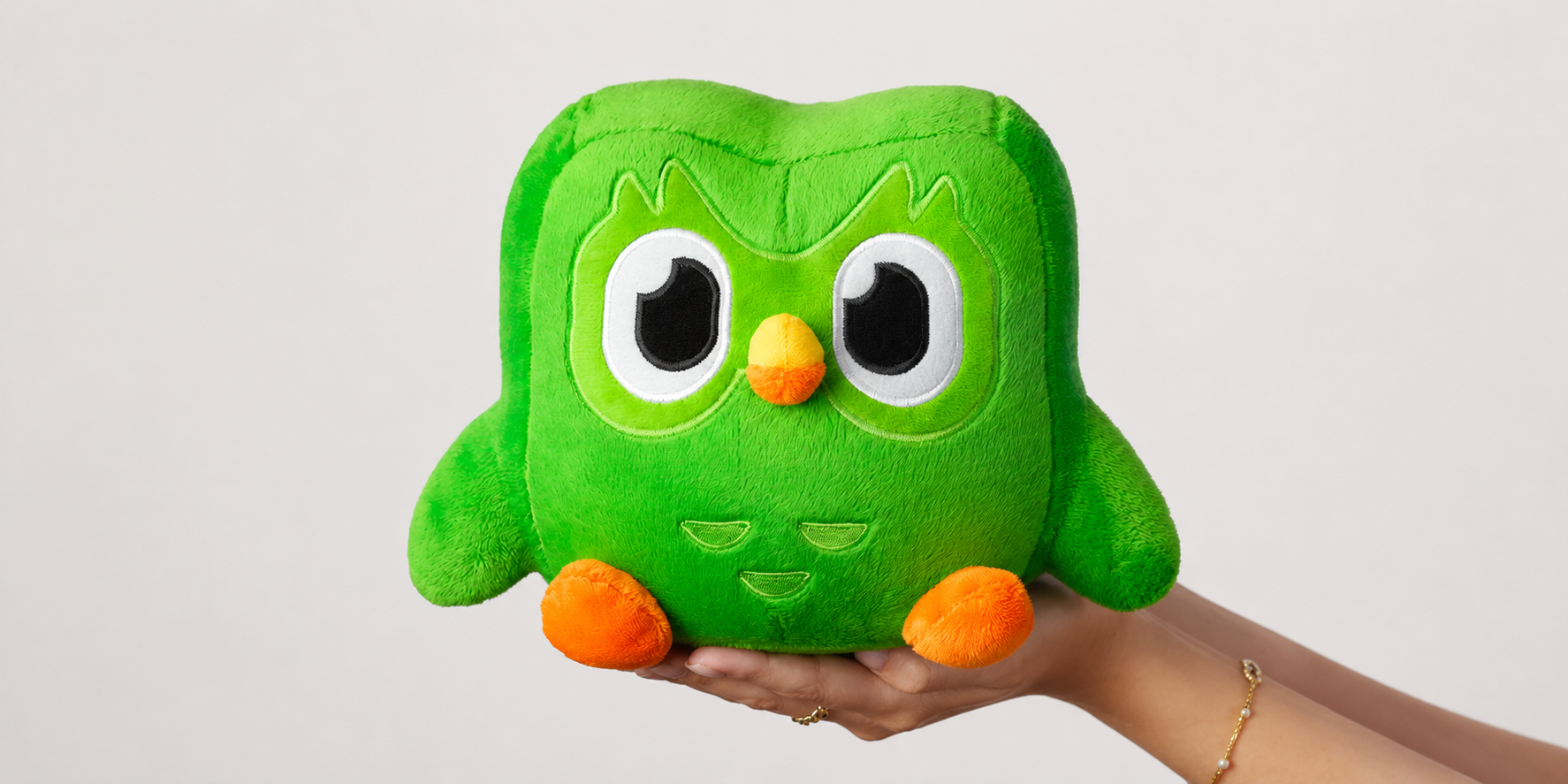
Image adapted from the Duolingo store.
Or, more importantly, can it exist off the screen? In a digital medium, a mascot can rely on animation, dynamic expressions, interactivity, and the product surrounding it. Strip all of that away, and the character has to be compelling enough that someone would want to hold it in their hands.
A plushie, or stuffed toy, is the easiest way to picture that shift. If someone on your team said “let’s make a plushie of our mascot” tomorrow, would you be able to pull it off? It sounds like a merchandising question, but it’s really a question about whether the character can exist outside a screen at all.
Mascots who already made the leap
Duolingo’s owl mascot, Duo, has escaped the app entirely. It’s Duo’s world and we’re just living in it. He dances across conference stages, photobombs fans, stars in viral marketing stunts, and sits as a plushie on shelves worldwide.
The M&M’s mascots started even further from the screen. They first appeared in print advertising back in the 1950s, and have evolved into the collectibles, store displays, Christmas ornaments, and costumed characters people recognize today.
Both Duo and the M&M’s mascots started as characters representing a brand. Neither stayed confined to the medium they were created in.
Becoming physical exposes the design
Not every mascot makes that jump gracefully, and some can’t make it at all. Take a character built almost entirely from swirling smoke or an orb with a shifting gradient face. There’s nothing solid there to mold, build, or hold. Floating limbs need something to attach to. A texture that only works as a rendering effect disappears once there’s no screen to render it on.
That’s a real loss, not just an inconvenience. A mascot that only works on a screen can only ever reach people while they’re staring a screen.
The physical world changes the relationship
Once a mascot exists outside a screen, its relationship with people changes. It stops being something people only encounter while using a product and starts becoming something they seek out on its own. With Duo, people line up to take selfies with him, rock green owl backpacks to school, buy blind boxes to collect figurines, and invite a six-foot-tall owl to their conferences.
That’s a different kind of relationship than most brands ever get to have with their audience.
The takeaway
Asking whether your mascot could survive as a plushie was never really about merchandise. It’s about whether the character can hold up outside the digital format it was born in.
We help brands design mascots strong enough to leave the screen. Interested? Let’s talk.